
Google’s “site reputation abuse” policy is aimed at third-party content published on a respectable site mainly to borrow its ranking power. Google announced it in March 2024. Sponsored posts are the obvious example, and I had around 2,280 of them on the community radio station website I run. This is what I found when I finally went through them on 29 September 2026.
What I found
All the sponsored posts sat in one category. I sorted them by topic and it was not a pretty list: gambling, kratom and CBD, crypto, payday loans, US injury lawyers, essay-writing services and buy-followers sites. Only 7 of the 2,280 had rel="sponsored" on the paid link.
The bit that stung is that back in June I’d told the site to protect that category from my noindex rules, so those posts would stay in Google for ever. I’d been looking after the riskiest content on the whole site, and had it exactly the wrong way round (there’s nothing like a clean-up to find your own mistakes!).
What I did
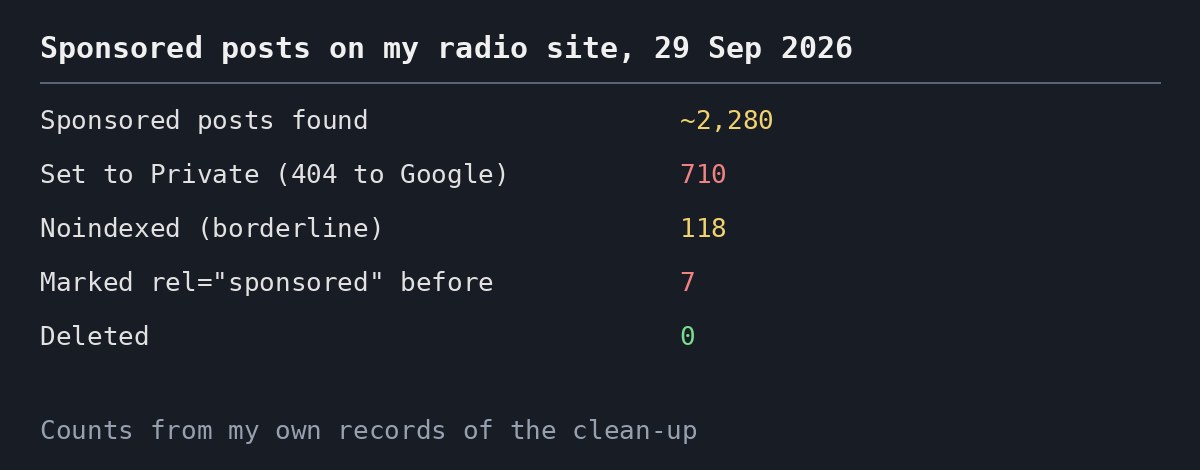
- 710 high-risk posts set to Private. A private post returns a 404 to visitors and Google, but I can bring it back.
- 118 borderline posts noindexed. They stay on the site and Google is told not to index them.
- Everything else: indexed for 12 months after publication, then noindexed automatically.
- Deleted: none.
Before I touched anything I copied the posts into a backup table in the database and made a spreadsheet listing every post I changed, with the domains it linked to and how to reverse the change.
What I won’t accept now
I wrote myself a policy. I’ll say no to gambling, casinos and betting, drugs, CBD, kratom and vaping, crypto and trading, payday loans and credit, adult and dating, essay-writing, buy-followers and SEO services, and US legal claims. Everyday subjects such as home, retail, broadband, travel, sport and local news are fine. The terms now say that sponsored posts “remain in search results for 12 months”, so buyers know what to expect.
What I haven’t done yet
I haven’t added rel="sponsored" to the existing paid links. Google is strictest about that one, and buyers like it least, so I’ve put it off until my 1 November check. It can be added at display time without editing a single post. Whether that is the right call, I’ll know better then.
I also expect a small dip. Three old sponsored posts (carpet moths, Instagram usernames and switchgear) made up around 20% of my Ahrefs traffic estimate. That traffic was never anyone who’d listen to a radio station.
Is it enough?
I don’t know yet. Search Console shows no manual action and no security issues, so the drop in traffic is algorithmic. That means there is nothing to ask Google to review. You fix the causes and wait. My own working guess is 6 to 18 months, with the first sign no earlier than the start of 2027.
If you run sponsored or guest posts, the test I’d borrow is simple: sort every one by topic and count how many have a rel="sponsored" link. I had 7 out of 2,280!
This is the second in a short series. The first was about pages that Google crawled and didn’t index.