
If you open the Page indexing report in Google Search Console and find a huge number next to “Crawled – currently not indexed”, you’re in good company. On the community radio station website I run, it said 39,688 in May 2026. The site has about 32,000 posts, so Google was telling me it had read more pages than I’d ever written! Here is what that message means, what I did about it, and what has (and hasn’t) changed so far.
What “crawled – currently not indexed” means
Google fetched the page, read it, and decided not to put it in its index. Nothing is broken. There is no 404, no block in robots.txt and no server error, so there is no fix to apply. It’s a judgement about the page. That makes it different from “Discovered – currently not indexed”, where Google knows the page exists but hasn’t looked at it yet.
One or two of these on a small site is normal. 39,688 is a pattern, and the pattern is the useful bit.
What was on my pages
A huge chunk of the site was show recaps. Each one had an embedded player, a track list and a line or two of text. They were fine for someone who’d just heard the show and wanted the playlist, but they were never going to be a good result for anyone searching Google. My Ahrefs traffic estimate had fallen from about 2,100 visits a month to about 357 by May 2026, after Google’s 2024 updates aimed at unhelpful content, so I took the hint.
What I did: noindex, not delete
I went through about 200 categories. 121 of them were show recaps and went on a noindex list, and the other 79 stayed as they were. I also noindexed any post with under 100 words of real text, whatever category it was in. That’s two rules, and I run them in the theme’s functions file:
const NOINDEX_CATEGORY_IDS = [101, 102, 103];

function should_noindex(array $category_ids, string $content): bool {
    // Posts in a category I've decided is recap-only
    if (array_intersect(NOINDEX_CATEGORY_IDS, $category_ids)) {
        return true;
    }
    // Anything with under 100 words of actual text
    return str_word_count(wp_strip_all_tags($content)) < 100;
}

add_action('wp_head', function () {
    if (!is_single()) {
        return;
    }
    $post = get_post();
    if (should_noindex(wp_get_post_categories($post->ID), $post->post_content)) {
        echo '<meta name="robots" content="noindex, follow">' . PHP_EOL;
    }
}, 1);
I chose noindex over deleting because it can be undone in a minute, and a delete can’t. The pages are still there for anyone who clicks a link to them. Google just isn’t asked to rank them.
Two things caught me out. First, Yoast still prints its own index, follow tag on the same page, which looks like a clash. It isn’t, because Google goes with the most restrictive of the robots tags it finds, so the noindex wins. Second, one show’s category was full of <pre> blocks that pushed the word count over 100, so the under-100 rule missed it and I had to add that category to the list by hand.
I also took the noindexed posts out of the XML sitemap. A sitemap is meant to list the pages you want indexed, and it’s daft to say both “index this” and “don’t” about the same URL.
What has changed so far
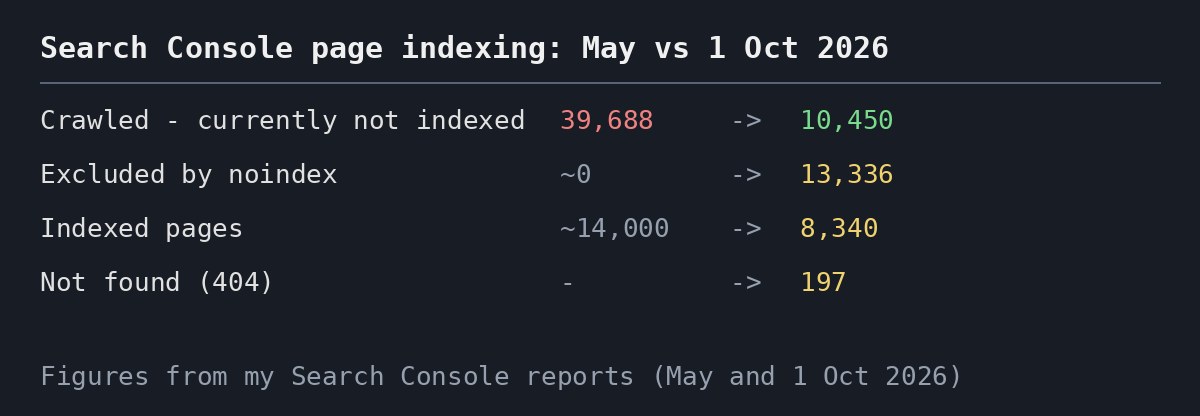
Here are the figures from Search Console on 1 October 2026 (Search Console runs about 3 to 4 weeks behind, so this is a snapshot and not a live reading):
- Crawled – currently not indexed: 39,688 down to 10,450.
- Excluded by noindex: from about 0 up to 13,336.
- Indexed pages: from about 14,000 down to 8,340.
Please don’t read that as a win. The first number fell partly because pages moved into the second bucket, and I now have about 5,700 fewer pages indexed. That was the aim, since I want fewer and better pages in Google. But my Ahrefs traffic estimate was 382 on 1 October, so nothing has come back yet. I don’t expect it to before December.
If you have the same message
- Open the report and look at 20 of the URLs, as a stranger would. Are they pages you’d want to land on?
- Look for what they have in common. For me it was categories. For you it might be tag pages, parameter URLs or old posts with a single paragraph.
- Decide for each group whether to improve it, noindex it or delete it. If you can’t improve it and nobody needs it, noindex is the safe middle.
- Then leave it alone for 6 to 8 weeks. Changing things every few days means you can’t tell what worked.
My next check is 1 November, when I’ll look at the same three numbers again.
The next two posts cover what I found when I looked at my sponsored posts (site reputation abuse) and why my site fell over every Tuesday (my own Ahrefs audit).